Postgraduate Research Training in Reproductive Health


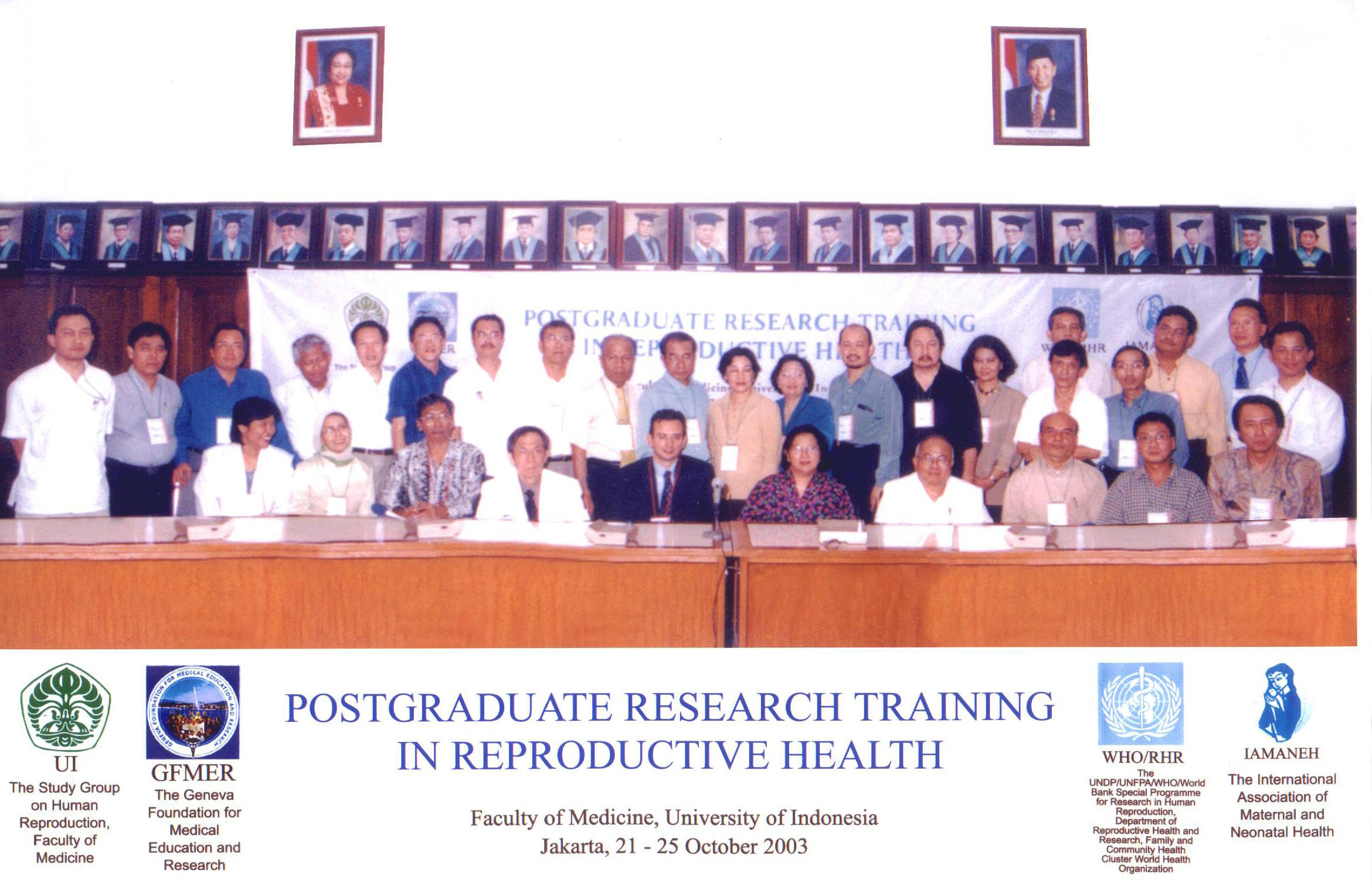
organised by
The Study Group on Human Reproduction, Faculty of Medicine, University of Indonesia (UI)
The Geneva Foundation for Medical Education and Research (GFMER)
The UNDP/UNFPA/WHO/World Bank Special Programme for Research in Human Reproduction, Department of Reproductive Health and Research, Family and Community Health Cluster World Health Organization (WHO/RHR)
The International Association of Maternal and Neonatal Health (IAMANEH)
in collaboration with
The Department of Health of the Canton
of Geneva
The Faculty of Medicine, Geneva University and
The Geneva Medical Association
POSTGRADUATE RESEARCH TRAINING IN REPRODUCTIVE HEALTH
Faculty of Medicine, University of Indonesia
Jakarta, 21 October - 9 December 2003
BACKGROUND
Indonesia is an archipelago consisting of more than thirteen thousand islands, lying between the Indian Ocean in the North and the Pacific Ocean in the East. With a population of more than 220 million in mid 2003, Indonesia is the fourth most populated country in the world after India, China and the USA.
The large population, high growth rate, maldistribution of the population, high mortality rate, low standard of living and large dependency rate, all of these factors contribute to Indonesia’s social, economic and development problems
The current challenge of reproductive health is that people have the ability to reproduce as well as to regulate their fertility, women are able to go through pregnancy and childbirth safely, the outcome of pregnancy is successful in terms of maternal and infant survival and well-being and, couples are able to have sexual relationships free of the fear of unwanted pregnancy and of contracting disease.
Looking at the magnitude of the challenge it is impossible to respond well without conducting research.
The Geneva Foundation for Medical Education and Research (GFMER) in collaboration with World Health Organization (WHO) has been conducting Postgraduate Research Training in Reproductive Health for doctors from all over the world since 1998. In order to disseminate the course to participants in different countries, GFMER is collaborating with Universities/Institutions.
University of Indonesia is the oldest university in Indonesia with more than 15,000 students and 13 faculties. At the Faculty of Medicine, research in reproductive health has been one of the priority. The Study Group on Human Reproduction has been very active in conducting studies in Reproductive Health.
It is planned to conduct Postgraduate Research Training in Reproductive Health at the University of Indonesia in collaboration with GFMER and WHO.
OBJECTIVES
General Objectives:
After completing the training, the participants will be able to write a dissertation (in English) based on the research studies conducted.
Specific Objectives:
After completing the training, the participant will:
- acquire the knowledge and skill of research methodology.
- be acquainted with new developments in reproductive medicine and reproductive biology
- be competent to use internet, Medline, Cochrane & WHO Reproductive Library and to communicate with others
- be competent in conducting/writing systematic literature review
- be competent in writing research proposals
- be conducting the above-mentioned research-studies
- publish the results of the studies in International Journals
- write a dissertation based on the above-mentioned published articles
LANGUAGE: The training will be conducted in English.
ORGANIZATION
The training is organized by The Study Group on Human Reproduction, Faculty of Medicine University of Indonesia (UI); The Geneva Foundation for Medical Education and Research (GFMER), The UNDP/UNFPA/WHO/World Bank Special Programme for Research in Human Reproduction, Department of Reproductive Health and Research, Family and Community Health Cluster World Health Organization (WHO/RHR); The International Association of Maternal and Neonatal Health (IAMANEH) in collaboration with The Department of Health of the Canton of Geneva; The Faculty of Medicine, Geneva University and The Geneva Medical Association.
International Steering Committee
- B. Affandi (University of Indonesia)
- A. Campana (GFMER)
- G. Carroli (Argentina)
- J. Chen (China)
- A. Doh (Cameroun)
- A.M. Gulmezoglu (WHO/RHR)
- M. Horga (Romania)
- R. Kulier (GFMER)
- R. Leke (Cameroun)
- M. Merialdi (Italy)
- J. Villar (WHO/RHR)
- D. Woods (IAMANEH)
Local Organizing Committee
- Chairman: Professor Biran Affandi
- Secretary: Dr. Sugito Wonodirekso, MSc
-
Members:
- Dr. Didi Danukusumo
- Dr. George Adriaansz
- Dr Soerjo Hadijono
- Ria Sonata, MPH, MSc
- Amir Alkhoiri, MPH
- Margie Wijiyanti, MPH
Resource Persons/Tutors/Lecturers
| B. Affandi (UI) | W. Ramelan (UI) |
| A. Campana (GFMER) | A. Firmansyah (UI) |
| J. Villar (WHO) | B. Basuki (UI) |
| F. Pralong (University of Lausanne) | G.H.Wiknjosastro (UI) |
| M. Gersbach (University of Geneva) | A.B. Saifuddin (UI) |
| R. Kulier (GFMER) | S. Sumapraja (UI) |
| F.J. Ndowa (WHO) | F.A. Moeloek (UI) |
| A.M. Gulmezoglu (WHO) | W. Corry (UI) |
| M. Merialdi (WHO) | B. Bourrit (GFMER) |
| E. Ezcurra (WHO) | J. Chen (WHO) |
PROGRAM
| Tuesday, 21 October 2003 Opening Ceremony |
|
|
0900 - 1000 |
Registration |
|
1000 - 1100 |
- Report of the Organizing Committee - Speech by Chairman, Doctorate Program, Faculty of Medicine - Speech by Dean, Faculty of Medicine - Speech by Director, Postgraduate Studies - Speech by GFMER/IAMANEH - Speech by WHO Representative - Official Opening by Rector, University of Indonesia |
|
1100 - 1300 |
Lunch |
|
1300 - 1330 |
Introduction to the Common Course (Merialdi/Affandi) |
|
1330 - 1415 |
The Gap between evidence and practice (Merialdi/Soerjo) |
|
1415 - 1600 |
Epidemiological studies (Merialdi/Basuki) - Cohort - Case control |
|
1600 - 1700 |
Randomized Controlled trials (Merialdi/Basuki) |
| Wednesday, 22 October 2003 | |
|
0800 - 1000 |
Methodological issues in: (Merialdi/Basuki) - Measurement of maternal morbidity/mortality - Chronic diseases - the use of anthropometry for evaluation of nutritional status |
|
1000 - 1100 |
Screening for obstetrics & intrapartum events (Merialdi/Affandi) |
|
1100 - 1200 |
Ethical aspects in Research (Merialdi/Affandi) |
|
1200 - 1300 |
Lunch |
|
1300 - 1400 |
Research Synthesis (Merialdi/Basuki) |
|
1400 - 1700 |
Meta-analysis (Merialdi/Basuki) - individual randomization & community trials - observational data |
| Wednesday, 22 October 2003 | |
|
0800 - 0900 |
Strategies for data analysis: Cohort studies (Merialdi/Basuki) |
|
0900 - 1045 |
Strategies for data analysis:RCT & Community interventions (Merialdi/Basuki) |
|
1045 - 1200 |
Critical appraisal of research reports (Merialdi/Affandi) |
|
1200 - 1300 |
Lunch |
|
1300 - 1500 |
Workshop: (Merialdi/Affandi) Critical appraisal of research paper |
|
1500 - 1600 |
Strategies for data analysis: Case-control (Merialdi/Basuki) |
|
1600 - 1700 |
Data analysis: Summary |
| Friday, 24 October 2003 | |
|
0800 - 0900 |
Powerpoint Presentation: practical issues |
|
0900 - 1130 |
Workshop: (Merialdi/Soerjo/Omo) - Computer, Internet and Medline - Cochrane Library - WHO Reproductive Library |
|
1130 - 1300 |
Friday prayer, Lunch |
|
1300 - 1700 |
- Practicum - Every participant makes a systematic review |
| Saturday, 25 October 2003 | |
|
0800 - 0900 |
Written examination |
|
0900 – 1300 |
Presentation of Literature Review (every participant) |
|
1300 – 1400 |
Lunch |
|
1400 – 1500 |
Assignment & Homework for the next 5 weeks, Closing |

DISTANCE LEARNING COMPONENT
| Week 1 | |
| 27 – 31 October 2003 | Basic pathophysiological
principles (Coordinator: F. Pralong / Didi Danukusumo, 8 hours) Genetics (Coordinator: M. Gersbach / Wahyuning Ramelan, 4 hours) |
| 1 November 2003 | Distance Written Examination |
| Week 2 | |
| 3 – 7 November 2003 | Family Planning (Coordinator: R Kulier / George Adriaansz, 12 hours) |
| 8 November 2003 | Distance Written Examination |
| Week 3 | |
| 10 – 14 November 2003 | Infertility, gynecological endocrinology & menopause ((Coordinator: A Campana / B.Affandi, 12 hours) |
| 15 November 2003 | Distance Written Examination |
| Week 4 | |
| 17 - 21 November 2003 | Obstetrics (Coordinator: AM Gulmezoglu / Gulardi Wiknjosastro, 12 hours) |
| 22 November 2003 | Distance Written Examination |
| Week 5 | |
| 24 – 29 November 2003 | Homework: Writing up Research Proposal |
| Week 6 | Reconvene in Jakarta |
| 9 December 2003 | |
| 0800 - 0900 | (Final) Written Examination |
| 0900 - 1200 | Presentation of Research proposal (each participant) |
| 1200 - 1300 | Lunch |
| 1300 - 1600 | Continued |
| 1600 - 1700 | Presentation of Certificate, Concluding remarks |