Reproductive health: Lecture plan - Sexual health: Lecture plan
Training in Research in Reproductive Health/Sexual Health 2005
Course Report
14 February – 25 March 2005
organised by
the Geneva Foundation for Medical Education and Research,
the International Association for Maternal and Neonatal Health (IAMANEH)
the UNDP/UNFPA/WHO/World Bank Special Programme for Research in Human Reproduction,
Department of Reproductive Health and Research; Family and Community Health
Cluster (WHO/RHR)
in collaboration with
the Department of Health of the Canton of Geneva
the Faculty of Medicine, Geneva University
and
the Geneva Medical Association
In 2005 it was the 14th time the Research
Training course was organised in Reproductive Health, and, parallel, for
the first time in the area of Sexual Health.
The objectives of both courses was to train health care professionals in
the area of clinical research, to enable them to identify the research needs
in their countries and to perform research projects of high
quality in the area of reproductive/sexual health.
The President of the Ministry of Health of the Canton of Geneva, Prof PF
Unger, opened the course on 14 February 2005 in the Executive Board
Room, WHO. Representatives from WHO, GFMER, the Geneva University, the Fonds
Maurice Chalumeau, and the Geneva Medical Association were speaking during
the opening ceremony. See pictures.
Participants
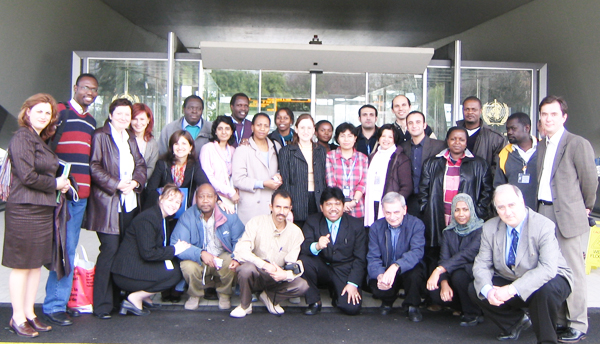
There were 33 participants from 28 different nations, of whom 28 received full study grants. See List of Participants - Reproductive Health; List of Participants - Sexual HealthTwelve participants came from Africa, 7 from Europe/ former Eastern Europe, 4 from the Eastern Mediterranean region, Asia and South America and 2 from North America. Two countries, Burundi and Latvia, were represented for the first time this year.
Course programme
Structure
Lectures were held every morning, Monday to Friday, in WHO. Afternoon sessions provided information about international health issues and offered an insight into WHO's work at the Geneva headquarters and its country activities. Other sessions provided practical guidelines on how to prepare a research proposal/ grant proposal, how to write a scientific paper and how to publish in international medical journals.During the first week , special sessions on the use of Internet and online databases, such as Medline were offered. Technical assistance from GFMER staff and WHO & University Library staff was available throughout the course.
Lectures
Participants from both courses attended the two weeks' course on Research
Methodology, which focussed on clinical research issues such as study
design, basic statistics, critical appraisal, systematic review of the literature
and ethical and human rights issues in research.
This was followed by a 3 weeks' course in Reproductive Health or Sexual
Health.
The Reproductive Health course comprised eight modules: Basic
Pathophysiological Principles; Genetics; Family Planning; Infertility; Gynaecological
Endocrinology; Genital Infections/Sexually Transmitted Infections and Cancers;
Obstetrics. See Lecture plan.
The Sexual Health course was structured around the following
topics: Research in Sexual Health, Sexuality (function and dysfunction),
Sexually transmitted infections/diseases, Sexual rights and ethics.
See Lecture plan.
Speakers were WHO staff from the Geneva headquarters, lecturers from the
Geneva University, GFMER and some invited speakers from academic institutions
abroad. More than 80 speakers and tutors were involved in the course. See
List of lecturers.
Certification
The course was under the supervision of the scientific committee, comprising members of the GFMER scientific board, WHO professional staff, representatives of the Geneva University and the Fonds Maurice Chalumeau. The scientific committee oversees the running of the course, decides on the scientific content and evaluates the participants.In order to obtain the certificate, participants had to pass an exam, consisting of 3 parts:
- a bibliographic review on a topic of their interest, under the supervision of a tutor
- 15 minutes oral presentation
- a multiple choice test
1) Scientific review
During the course participants had to write a scientific paper which contributed to their final assessment at the end of the course. This ' mini-thesis' gave participants the opportunity to apply the tools they learned during the course, such as critically appraising the literature, choosing the right study design or systematically reviewing the literature. Throughout the course participants could get advice from GFMER or WHO staff. Most of the reviews are available on our website. See Scientific reviews - Reproductive Health; Scientific reviews - Sexual Health
2) Oral presentationEach participant had to present her/his scientific review and respond to the questions of the scientific committee. The aim was that participants learn how to give a presentation, and get confidence in speaking to an audience.
3) Multiple choice testThe test consisted of 60 questions which were
drawn from the content of the course.
The final mark was a combination of all 3 parts and all participants had
passed.
Facilities
Throughout the course all students had access to personal computers (2 students sharing 1 computer) at the library of the Faculty of Medicine and the WHO library. Access to Internet and Medline enabled them to conduct the literature search, bibliographic review and prepare their written and oral presentation electronically. Basic training on the use of Internet, Medline and PowerPoint was provided. Two libraries (at the Faculty of Medicine and at WHO) were available for the participants and professional help from librarians could be obtained if necessary.Accommodation
Most of the participants stayed at 'Résidence Veyrier - Salève' or 'City hostel Geneva' located in the centre of Geneva.Follow-up and future projects
- Online Internet fora and e-mail lists are being established to monitor the progress of the research projects, assist participants and encourage exchange of information See e-learning.
- Collaboration with participants' institutions has been initiated to enable the dissemination of the Research Training course as previously: See Research Training Network.
- Online data entry systems have been created to assist participants and their institutions in planning and conducting research. See Internet-based clinical trials.
Funding
The course has been supported by the organizing institutions in collaboration with other Swiss and International Organizations. Funding for scholarships came from sponsors listed below, covering study grants for 28 participants, as follows:| Sponsor | Use |
| GFMER | 5 study grants |
| The World Health Organization (RHR/WHO) | 5 study grants |
| Fonds Maurice Chalumeau | 7study grants |
| The International Association for Maternal and Neonatal Health (IAMANEH) | 6 study grants |
| UNFPA Lithuania & Latvia | 2 study grants |
| Société Cooperative Medicale de Beaulieu | 1study grant |
| Geneva – Yaoundé Cooperation | 1 study grant |
| GFMER/WHO | 1 study grant |
Postgraduate Course (PGC) – Statistics and Historical Perspective
See also: Course Statistics 1992-2005Text prepared by Regina Kulier and Nathalie Recordon